This post may contain affiliate links. If you make a purchase through these links, I earn a small commission at no extra cost to you. As an Amazon Associate I earn from qualifying purchases. I appreciate your support of my blog!
Not having been home schooled myself, I was super excited…but also fairly terrified, when we made the decision to homeschool. We prayed over it quite a bit and felt God was calling us to it. Whether you are homeschooling from the start or pulling from public/private school, it can be extremely overwhelming.
There is so much information out there on what to do and what not to do. Then you have to pick a curriculum with everyone online saying opposite things about each one you look at. I wanted to have someone tell me exactly what would work perfectly for us, which of course is impossible.
We are now in our 4th year of homeschooling and we absolutely love it! In no particular order, I’ve written out some of the things that I wish someone had said to me when we first got started. I pray these tips would encourage you as you begin this journey. You’ve got this!
1. You and your child are a team
Kids are naturally curious and eager to learn about the world around them. There is no one who wants your child to learn, grow and succeed more than you do.
Together, you make the perfect team.
Your job is to facilitate the learning and build an environment where they can feel comfortable and confident to learn. Prepare your hearts by praying for wisdom, patience and protection over your relationship.
2. Figure out what type of learner your child is
We had to switch math curriculum a few times because I missed this step with my son. Learning how your child best takes in information can give you great insight as to which curriculum may work best for him or her. There are 4 main types of learners: Visual, Auditory, Reading/Writing and Kinesthetic.
If the child is younger, try simply observing how they interact with the world around them. If you are working with an older child, you can even ask them how they learn best. Do they enjoy hands on activities or prefer listening to a podcast? Are they naturally heavy readers? Do they like to see visual aids to understand new concepts?
A lot of curriculum companies will offer sample lessons as well that you can try out with your child prior to purchasing the curriculum. I highly recommend looking into companies that do this first and taking advantage of that offer.
We have personally loved The Good and The Beautiful for language arts and Apologia for math. Both offer free digital samples of several subjects.
3. Keep It simple to start
Speaking of math and language arts, stick with just these two at first. Trying to do too much at once may leave both you and your child overwhelmed and frustrated.
As you get your footing, and find out their learning style, you can add things into the fold based on interest. If you have an older child and need to cover other subjects right away, I recommend taking field trips. Learning can take place anywhere, not just in a textbook.
4. Don’t copy the public school schedule
Utilize the flexibility that comes with homeschooling. It is totally okay if your day looks nothing like public school. In my opinion, that’s actually kind of the point.
Whatever your reason is for homeschooling, you decided that that would be the better fit for your family. So it doesn’t really make sense to try and make your home a mini version of public school.
I have come to believe that learning should simply be a part of our daily life (more on that later).
5. Follow Behavioral Queues
We all have more or less energy at different times in the day, kids are no different. When we first started homeschooling, it seemed like everyone else I saw was doing homeschool in the mornings. We tried that but it just wasn’t working. My kids have too much energy in the mornings to focus and so I was left managing behaviors when I didn’t need to.
Outside of doing our Bible time over breakfast, our mornings remain open. We do our daily lesson(s) in the afternoon because that’s what works for our family. This simple shift helped so much with focus and attention span when it came time for sit down work.
I go over our full daily routine here if you are interested.
6. Start out with year round homeschooling
You don’t have to continue this way forever…but you might want to. In the beginning, I highly recommend trying year-round homeschooling. And while you can totally do a 3-5 day schedule, I dive into why we homeschool year-round, every day, in this post.
Of course you can take days off whenever needed, but otherwise just make the schoolwork a part of your daily routine. Not only does this mean that you have to do less sit down work each day, but it also eliminates having to get back into the routine every Monday morning.
We love this way of learning so much because it allows us to only spend about 20 to 30 minutes a day doing sit down work and we still end up finishing a year worth of curriculum in 9 months or less including time off here and there.
7. it is okay to intentionally change curriculum
I recommend trying out samples of curriculum first whenever possible, but you may at some point come across something you thought would work…and it just doesn’t.
When this happens, there are two options. First, I would try making it work. This may mean getting creative by adding manipulatives in math or supplementing with Bob books in Language Arts. These are both things we did early on. For language arts, it worked perfect. Math…not so much.
I thought my son would love using all the fun manipulatives that come along with math while I taught the lesson. I didn’t know at the time that he has more of a reading/writing learning style. The things I bought to help me teach him were just distracting and confusing him.
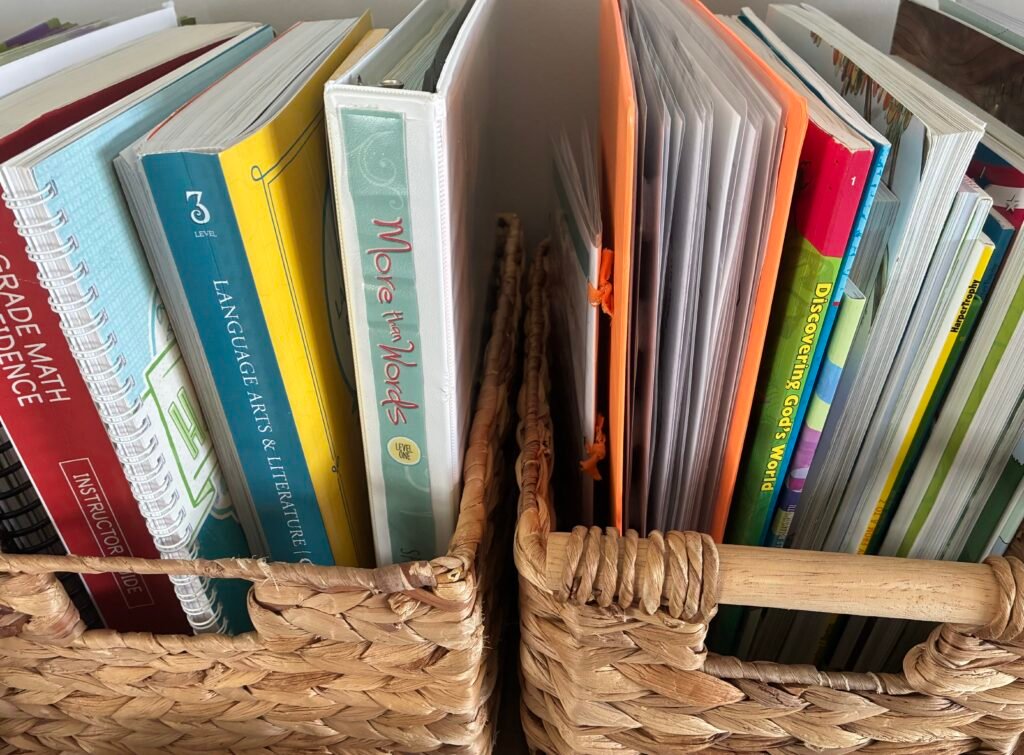
After trying Math with confidence (great for auditory/kinesthetic learners) and The Good and The Beautiful (was just a bit too fast paced for us), we settled on Apologia math. We are in our second year now using it and it’s our favorite by far.
Try and make the curriculum you chose work if you can, switch if you truly need to. Just remember that changing curriculum also takes quite a bit of work.
8. read, read, and read some more
When all else fails and the day isn’t going as planned, dive into some good books. Not only is this also homeschool, but it provides joyful bonding with your child. This can be so helpful when it has been a rough day.
Despite my son fully reading on his own, he still loves it when I read to him. Right now, we are reading through The Little House on the Prairie Series.
9. set a timer
You may find this to be helpful with all subjects; but for us, we set a timer for math. It’s still not my son’s favorite subject and so having a timer set helps him know the lesson will in fact not last forever.
The timer sets the expectation and when time is up, he can choose to stop or finish up. He also enjoys trying to beat the timer, which he does frequently.
10. slow down, take a breath, and pray
Some days will be easy, joy filled, and super productive. Others…not so much. Luckily, you already have some experience with the beautiful roller coaster ride of parenting. Like parenting, homeschooling is a long journey but worth every step.
Pray and ask God to help you and your child in any areas where you may be struggling. Remember, your relationship with your child is so much more important than finishing any lesson. Slow down and enjoy the time and freedom homeschooling gives. You can do this! I’m rooting for you!
Happy Homeschooling!

Sign up for our monthly newsletter below!